
What is Enterprise Resource Planning (ERP)?
Enterprise resource planning (ERP) is business process management software that manages and integrates a company’s financials, supply chain, operations, reporting, manufacturing, and human resources activities. ERP is not just accounting software.
Instead of maintaining separate systems for Finance, Procurement, Inventory, Manufacturing, and Human Resources, an ERP system brings these functions together in an integrated platform.
Why Do Organizations Need ERP?
As businesses grow, managing different departments independently becomes increasingly complex. Each department may maintain its own data, applications, and processes, leading to duplicated information, communication gaps, and operational inefficiencies.
ERP helps organizations overcome these challenges by providing a centralized platform for managing business operations. ERP system typically supports several important business functions.
- Financial Management
- Supply Chain Management
- Operations Management
- Reporting and Analytics
- Manufacturing Management
- Human Resources Management
Microsoft Dynamics 365 ERP
In today’s competitive business environment, organizations need integrated systems to manage their financial operations, supply chains, manufacturing processes, procurement, inventory, and other critical business activities.
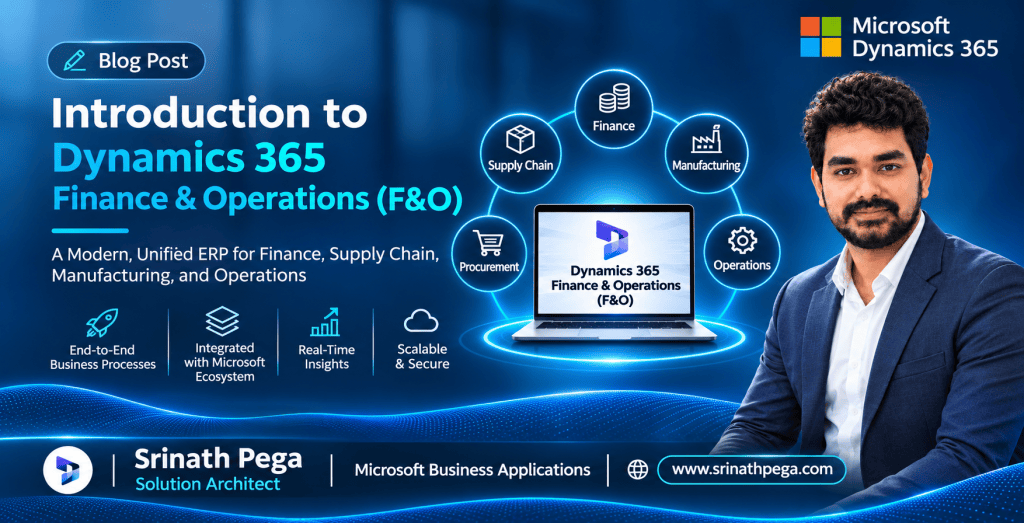
Managing these operations across multiple disconnected systems can lead to data inconsistencies, operational inefficiencies, and limited business visibility. This is where Microsoft Dynamics 365 Finance & Operations (F&O) comes into the picture.
Microsoft provides a collection of business applications under the Dynamics 365 platform to support enterprise resource planning requirements. The major applications include:
- Dynamics 365 Finance: Supports financial management, accounting, budgeting, financial reporting, and organizational financial operations.
- Dynamics 365 Supply Chain Management: Supports procurement, inventory, warehouse management, manufacturing, and supply chain operations.
- Dynamics 365 Commerce: Supports retail operations, point-of-sale (POS), e-commerce, pricing, and omnichannel customer experiences.
- Dynamics 365 Human Resources: Supports employee administration, HR processes, and workforce management.
- Dynamics 365 Project Operations: Supports project-based businesses through project planning, resource management, time and expense tracking, project costing, and billing.
Dynamics 365 F&O helps organizations manage how money flows, how products are purchased and manufactured, how inventory is maintained, and how products are delivered to customers.
Real-World Business Example
A furniture manufacturing company receives an order from a customer. The business process involves multiple departments:
- Sales: Receives and records the customer’s order.
- Inventory: Checks the availability of finished products and raw materials.
- Procurement: Purchases additional materials when required.
- Manufacturing: Plans and produces the required furniture.
- Warehouse: Manages finished goods and product delivery.
- Finance: Generates invoices, records revenue, and tracks customer payments.
- Human Resources: Manages the employees involved in business operations.
An ERP system connects these departments and enables information to flow across the organization.
Enterprise Resource Planning plays an important role in modern organizations by integrating business functions into a centralized management system.
Microsoft Dynamics 365 provides ERP applications that help organizations manage financials, supply chains, manufacturing, commerce, human resources, and project operations.
Hope you learn something, Thanks for Reading 📖!
Happy Power365ing!

